
How Automotive Student Testing Helps Instructors Identify Learning Gaps Earlier
One of the most difficult parts of teaching automotive technology is not always the lesson itself. It is knowing which students are truly understanding the material and which students are quietly falling behind.
In many classrooms, struggling students do not always raise their hands. They may stay quiet, avoid asking questions, or appear to be following along when they are actually missing important concepts. By the time the next major test arrives, those gaps can become much harder to correct.
That is where Automotive Student Testing can make a major difference.
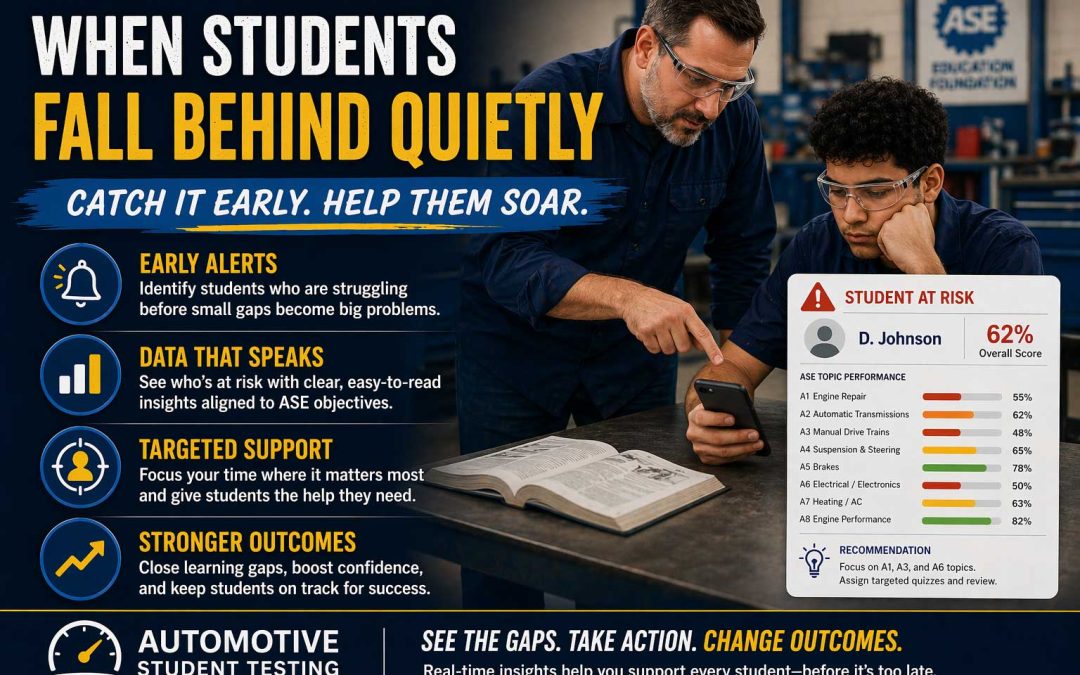
Automotive Student Testing gives instructors a practical way to identify learning gaps earlier through targeted quizzes, ASE-style assessments, performance tracking, and clear reporting tied to ASE content areas. Instead of waiting for a major test to reveal where students are struggling, instructors can use smaller, more consistent assessments to see what students understand as they move through each unit.
This gives teachers more useful information while there is still time to act.
Smaller Assessments Can Reveal Bigger Problems
A student may understand part of a topic but struggle with a specific content area. For example, a student might perform well overall in brakes but have difficulty with hydraulic system diagnosis, ABS operation, or disc brake service procedures.
Without targeted assessment data, those weak spots can be easy to miss.
Automotive Student Testing helps instructors break performance down into more meaningful information. With 10-question quizzes, timed and untimed tests, and detailed reports, instructors can see where students are doing well and where they need additional support.
That means less guessing and more focused instruction.
Better Data Helps Instructors Respond Faster
Classroom signals can be vague. A student may look engaged but still misunderstand key concepts. Another student may be quiet but performing well. Others may struggle only in certain areas and need a quick reteaching session before moving forward.
Automotive Student Testing helps make those situations clearer.
With performance tracking and reporting, instructors can quickly identify students who may need help before they fall too far behind. That allows teachers to adjust instruction, review specific content areas, provide individual coaching, or group students by need.
The goal is not just to test students more often. The goal is to give instructors better information at the right time.
Less Assessment Work. More Teaching Time.
Creating quizzes, grading tests, tracking results, and identifying patterns can take a significant amount of time. Automotive instructors already have a lot to manage, including classroom instruction, lab activities, safety procedures, student questions, and program requirements.
Automotive Student Testing helps shoulder much of the assessment workload.
Because the system is built around ready-to-use automotive assessments and reporting tools, instructors can spend less time building and interpreting assessments from scratch and more time helping students improve.
That means more time for coaching, reteaching, lab reinforcement, and preparing students for long-term success.
Supporting Students Before the Next Major Test
The best time to help a struggling student is not after they fail a major test. It is before that test ever happens.
By using Automotive Student Testing throughout the learning process, instructors can identify weak spots earlier, reinforce key skills, and give students more opportunities to correct misunderstandings. This creates a stronger path toward better test performance, stronger classroom outcomes, and greater confidence.
When instructors can see where students are struggling, they can respond with purpose.
Automotive Student Testing helps make that possible.
Request Your Free Trial
Do not wait until the next major test to find out which students are falling behind.
Request your FREE trial today and discover how Automotive Student Testing helps you spot struggling students earlier across your entire program.