
Raise the bar with ASE-aligned, classroom-ready exams
Raise the bar with ASE-aligned, classroom-ready exams
Give your program a reliable way to measure learning and readiness. Automotive Student Testing now offers Standardized Tests that mirror ASE Entry-Level Certification exam structure—so instructors can assess progress with confidence and students can practice in a format that feels familiar on test day.
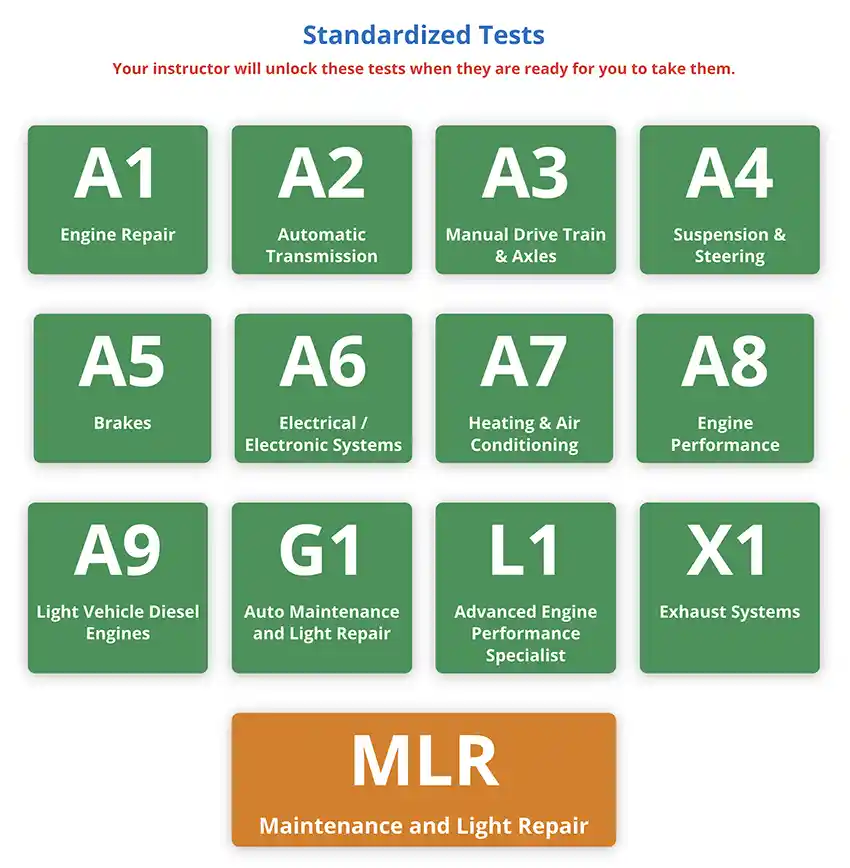
What’s covered
Comprehensive coverage across core and advanced areas:
- A1–A8 (Automobile & Light Truck)
- A9 (Light Vehicle Diesel Engines)
- G1 (Auto Maintenance & Light Repair—Professional)
- L1 (Advanced Engine Performance)
- X1 (Exhaust Systems)
- MLR (Maintenance & Light Repair—Student)
Each test follows the same number of questions as the ASE Entry-Level Certification format for that subject, so your students build the right endurance and timing from day one.
I have been using Automotive Student TEsting since 2020 and I use the platform to assist in preparing my students for the ASE Student exams. Automotive Student Testing is so beneficial because each student has their own account and they’re able to take practice tests with results and feedback provided to both the student and myself. I have searched and haven’t found a comparable site to what they are providing for each student.
Why standardized tests matter (for schools and students)
For instructors
- Clear, comparable results: Consistent test lengths and difficulty let you benchmark across classes, terms, and cohorts.
- Targeted instruction: Identify strengths and gaps by ASE Content Area to fine-tune lessons and labs.
- Program accountability: Produce data that supports EOPAs, advisory boards, accreditation reviews, and grant reporting.
For students
- Real exam practice: Train on the same format they’ll see on high-stakes tests, reducing anxiety and improving performance.
- Mastery over memorization: Randomized delivery and wide item pools keep students thinking—not guessing.
- Motivation through milestones: Standardized checkpoints make progress visible and goals concrete.
Integrity by design: randomized for every student
Every standardized test is algorithmically randomized per student, significantly curtailing cheating and preventing answer-sharing. Randomization preserves exam integrity while still aligning to the same blueprint and question count.
Instructor controls you can trust
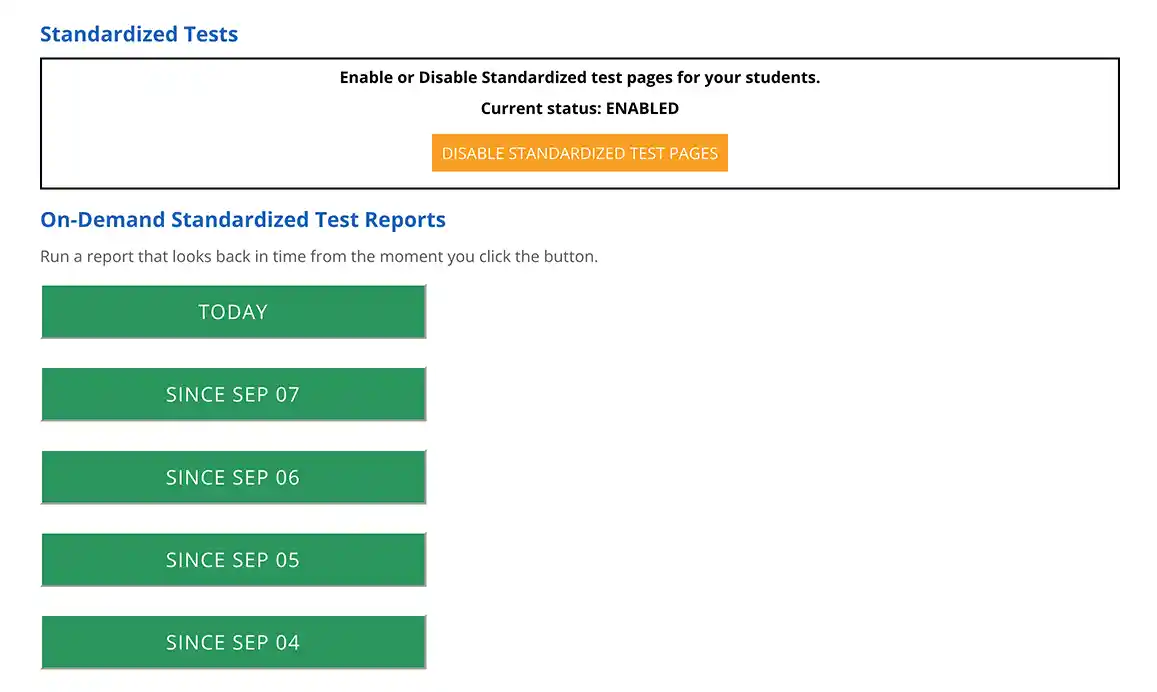
You decide when students can access standardized tests.
- Enable/Disable per test: Turn standardized tests on only when you’re ready to administer; keep students off to prevent premature practice.
- Schedule access windows: Open a test for a class period, a day, or a week—then close it to preserve integrity.
- Prerequisites & sequencing: Require completion of quizzes or unit modules before unlocking a standardized test.
Why limiting access matters
- Prevents overexposure: Unlimited attempts can train to the test rather than the tasks.
- Protects validity: Controlled availability keeps results meaningful for grading and program evaluation.
- Supports pacing: Release tests at key milestones (midterm, pre-EOPA, end-of-term) to reinforce learning cycles.
- Reduces anxiety: Clear windows and expectations help students prepare, not panic.
How it works (at a glance)
- Select the ASE area (e.g., A5 Brakes, G1, MLR).
- Confirm format & timing (pre-matched to ASE Entry-Level question counts).
- Enable when ready and set your access window.
- Students test on any device with a modern browser.
- Review results instantly—overall score plus breakdown by ASE Content Area.
Data & reporting you can use
- Cohort and individual performance with ASE Content Area detail
- Completion time analytics to spot rushing or pacing issues
- Exportable summaries for LMS records, parent conferences, or advisory meetings
Best-practice rollout (recommended)
- Weeks 1–4: Instruction + low-stakes quizzes for formative feedback.
- Week 5 or mid-term: Enable a standardized test to benchmark progress.
- Pre-EOPA: Open a final standardized test to simulate test-day conditions.
- After action: Use Content Area reports to target last-mile review.
FAQs
Q: Are these identical to ASE Entry-Level exams?
A: They mirror the number of questions and follow ASE-style structure, terminology, and task alignment, while remaining instructional assessments for your program.
Q: Can students retake standardized tests?
A: That’s up to you. We recommend limiting retakes and using access windows to preserve integrity and keep results meaningful.
Q: How do you prevent cheating?
A: Each student receives a randomized version of the exam. Combined with controlled access, this dramatically reduces answer-sharing and patterned memorization.
Q: Do these work alongside quizzes and unit tests?
A: Yes. Use quizzes for ongoing learning and Standardized Tests for milestone checks and readiness verification.
Bring standardized confidence to your shop & classroom
Put consistent, ASE-aligned assessments at the heart of your program—on your schedule, with your controls, and backed by actionable data.