For automotive programs, student success is measured by more than grades, attendance, and completion rates. Increasingly, schools are expected to demonstrate that students are leaving their programs with the knowledge, skills, and industry-recognized credentials needed to enter the workforce.
For ASE Accredited automotive programs, ASE Entry-Level Certification can be an important part of that measurement.
And for administrators, stronger certification results can mean more than another achievement to include in an annual report. Depending on your state’s Career and Technical Education funding and accountability structure, industry-recognized credential attainment may contribute to the performance measures used to evaluate programs, justify funding, secure additional resources, or demonstrate the value of continued investment in automotive education.
That makes one question particularly important:
How many of your automotive students are actually prepared to pass their ASE Entry-Level Certification tests?
Certification Results Provide Measurable Evidence of Student Success
Automotive programs invest considerable resources in instructors, equipment, facilities, curriculum, tools, technology, and training.
Administrators need measurable results that demonstrate those investments are producing outcomes.
When students successfully earn ASE Entry-Level Certifications, your program has another quantifiable result it can present to:
- School and district administrators
- State CTE officials
- Advisory committees
- Parents
- Community partners
- Automotive employers
- Prospective students
- Funding and grant decision-makers
A growing number of successful certifications provides tangible evidence that students are learning the material and developing the knowledge expected by the automotive industry.
Stronger Credential Attainment Can Strengthen Your Case for Funding
CTE funding structures vary considerably from state to state. However, industry-recognized credential attainment is an important performance measurement within Career and Technical Education.
For that reason, improving certification outcomes can strengthen the overall performance story your automotive program presents.
Consider the difference between reporting that: 40 students completed an automotive program.
and reporting that: 40 students completed the program and 35 earned one or more recognized automotive certifications.
The second statement provides an additional measurable outcome demonstrating workforce readiness.
For administrators seeking to maintain, defend, or expand automotive program resources, those results can be extremely valuable.
The Problem: Finding Out a Student Wasn’t Ready Too Late
One of the greatest challenges with certification testing is timing.
If the first time an instructor discovers that a student is weak in electrical systems, brakes, steering and suspension, engine performance, or another critical area is when that student fails a certification exam, the opportunity to intervene may already have passed.
Automotive Student Testing was designed to help prevent that.
Instead of treating certification preparation as something that happens at the end of a semester, AST allows instructors to continuously measure student readiness throughout the educational process.
Identify Weaknesses While There Is Still Time to Correct Them
Automotive Student Testing provides instructors with ASE-aligned assessments that can be used before, during, and after instruction.
Students can complete:
- 25-question timed tests
- 25-question untimed tests
- 138+ focused 10-question ASE content-area quizzes
- Standardized assessments
- Key Terminology exercises
- Animated instructional videos
- Animated schematics
- Oscilloscope training resources
These tools allow instructors to identify exactly where students are struggling.
A student may understand most of an ASE area while having difficulty with one particular content category. AST’s focused quizzes make it possible to identify that weakness and address it before certification testing.
That changes assessment from simply measuring performance to helping improve performance.
Weekly Reporting Gives Administrators and Instructors Visibility
Assessment is much more valuable when instructors can easily see what the results are telling them.
Automotive Student Testing includes weekly automated progress reports that provide a continuing view of student activity and performance.
Instructors can quickly identify:
- Students who are consistently performing well
- Students whose scores are improving
- Students who may be falling behind
- Content areas creating difficulty
- Students who may need additional preparation before certification testing
AST also provides on-demand reporting, allowing instructors to examine student, class, quiz, and content-area performance when additional detail is needed.
This gives programs something extremely important: Data before the final outcome.
Instead of waiting for ASE Entry-Level Certification results to determine whether students were prepared, instructors can monitor readiness throughout the semester.
Turn ASE Preparation Into a Continuous Process
One of the most effective ways to improve certification performance is to integrate assessment into normal classroom instruction.
AST can be used for:
- Beginning-of-course benchmarks
- Monday warm-up quizzes
- Bell work
- Exit tickets
- Homework assignments
- End-of-topic assessments
- Midterm evaluations
- Certification preparation
- Remediation for struggling students
Because AST is smartphone-friendly, students can also continue preparing outside the classroom using the devices they already carry.
Certification preparation no longer needs to be limited to a few review sessions immediately before testing.
It can become part of the entire educational experience.
More Prepared Students Can Mean More Successful Certifications
The objective is straightforward.
Identify weaknesses earlier.
Give instructors better information.
Give students more opportunities to practice.
Improve readiness before certification testing.
When more students successfully earn ASE Entry-Level Certifications, your program gains measurable evidence that its instructional efforts are working.
Those results can strengthen conversations about program performance, employer readiness, accountability, continued investment, and—depending on your state’s funding structure—CTE funding opportunities.
Don’t Wait Until Certification Day to Measure Readiness
Administrators spend considerable time evaluating curriculum, equipment, instructional resources, program performance, and student outcomes.
Certification readiness deserves the same level of visibility.
Automotive Student Testing provides a practical way to measure student progress throughout the semester while giving instructors resources they can immediately use to improve performance.
And because everything is already built and ready to use, instructors do not have to spend hours creating assessments or building another complicated learning management system.
Students register.
Instructors teach.
AST helps measure the results.
See What Automotive Student Testing Can Do for Your Program
Automotive programs can experience the complete AST system through a 30-day free trial with no cost or obligation.
Put Automotive Student Testing in the hands of your instructors and students. Review the weekly reports. Identify weaknesses. Measure progress.
Most importantly, see how much more clearly your program can measure ASE readiness before students sit for their certification exams.
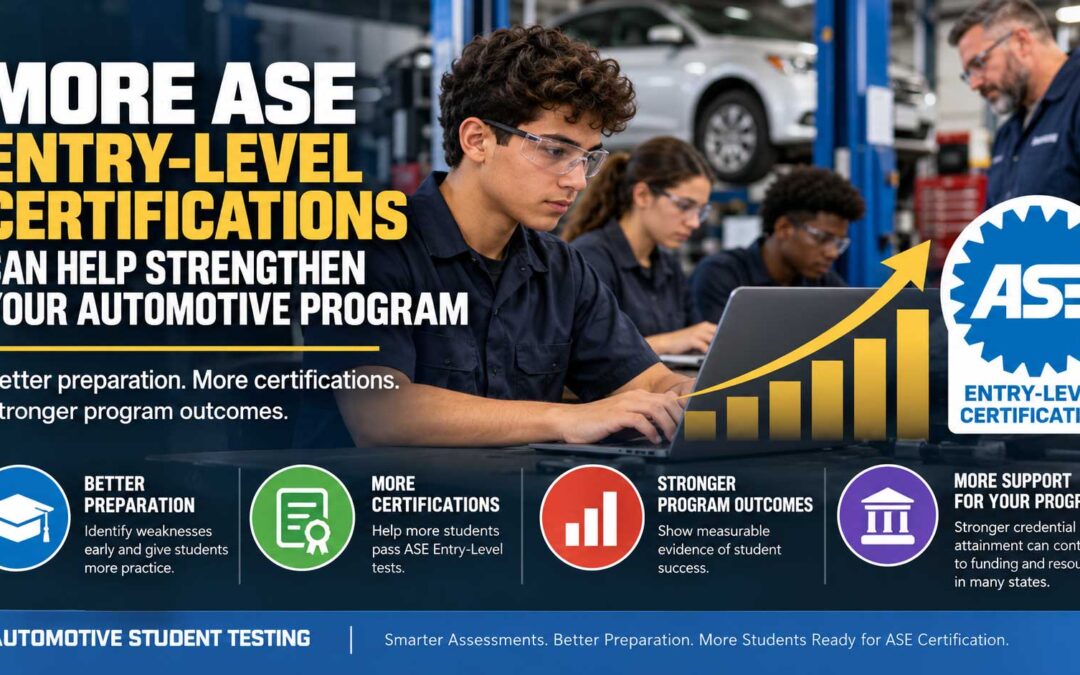
Better preparation can lead to more certifications. More certifications create stronger measurable outcomes. And stronger outcomes can help demonstrate why your automotive program deserves continued investment.
Smarter Assessments. Better Preparation. More Students Ready for ASE Certification.
Learn more or request your free trial at AutomotiveStudentTesting.com.